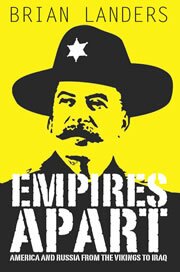
Empires Apart: America and Russia from the Viking to Iraq
by Brian Landers
ENDORSEMENTS FOR EMPIRES APART
LOBSTER 57
Moscow on the Hudson?
John McFall
Is America an empire? Tsarist Russia and its Soviet successor were certainly seen as such through western eyes. That America is not shows the heavily ideologised world through which we frame history. In a bold sweep of historical comparison of the two world titans, Mr Landers attempts, in his first major work, to correct such ideological distortions in an agnostic, sardonic and wonderfully written treatment of his subject. Juxtaposing Russia’s avowedly imperialist history with anti-imperialist America he demonstrates the ‘continuity of empire’ in each nation’s seemingly incongruous histories in a convincing, skilful presentation of their similarities yet fundamental differences.
This is a great book. Topical, thoroughly enjoyable, and packed with information and interpretative controversy. Like most historical studies it combines description, analysis, and narrative. In this case the analysis is largely sewn into and revealed through the narrative. The two nations are deemed by many as not comparable, even ‘poles apart’. This book challenges such conventional historical wisdom by taking the existing historical record and rewriting it. No new bombshell discoveries are presented. Instead, the book aims at freeing history from the ‘distorting prism that refracts the present’. The real strength of this book lies in its quality as an extremely subtle, critical and bold interpretative thesis, not as a conventional textbook that covers dates and events. Full of startling historical content as it is, it’s the ideology critique that appeals most.
Much of the older literature on empire is favourable, eulogistic. Great empires have brought with them grand accomplishments: culture, civilisation, peace to previously squabbling tribes and so on. This book effectively and comprehensively rubbishes any such notions. Witty and provocative throughout, connections and parallels between ‘democratic’ America and ‘autocratic’ Russia are made by continually shuttling back and forth through their forgotten and remembered histories and their consequent ideological self-understandings. It strips each nation’s ideological pretensions bare.
Beginning with a controversial common point of European origin in the Vikings’ freebooting journeys west to the New World and east to Europe and the near Asia, we trace the genesis of each empire’s respective path. Like the first Americans, the Viking Rus of Kiev had to fight their way towards the Pacific in pursuit of territorial gain and security. Americans distortedly see their origins in the pious ‘Pilgrim Fathers’ fleeing from religious persecution on The Mayflower in the 1620s. The earlier European colonists and the 375 plus languages that the native Americans spoke for centuries before are airbrushed out of the story. Honest toil and God’s providence for his ‘chosen people’ gave the early fundamentalist colonists the sense of ‘manifest destiny’ that led eventually to the conquering and subjugation of the whole continent. A destiny built on the horrors of ethnic massacres, exploitation and the ‘sweet sacrifice’ of ‘frying natives’ is not the preferred foundation myth of today’s America.
So, too, the Russians. Although their ultimate origin is unknown, the eastern Slavic strand of their roots is the privileged source in official Russian history. Defying the Mongol hordes of the east and the barbarians from the west, it’s an affront to the Slavophile soul that the glories of Russia could also stem from a rapine western non-Slavophile source and an autocratic Mongol legacy. Their sense of having a unique non-western European and non-Asian identity forecloses this. Confronting these foundation myths, the national imperial ideologies that derive from them, and the rewriting of popular history necessary to confront them, is the historian’s task. The author’s narrative relentlessly unfolds to this end throughout.
Parallels and contrasts
Despite huge differences in geography, history, ideology, culture, politics, religion, law and attitude, the striking contrast between the two are the attitudes and policies of each towards their own societies: one democratic, the other autocratic. ‘American history is Russian history writ small’ it is contended (except in the preponderance of overall US military interventions overseas, and in particular post-WWII as the US model came to triumph). The following are used to develop this theme. The American west was Siberia on a smaller scale; the treatment of American native tribes was dwarfed by Stalin’s deportation and massacres; the scale of wholesale ethnic cleansing; the scale of the respective Afghanistan invasions and number of deaths; the lynchings of blacks compared to the pogroms of Jews. (Is there really, however, a comparison with the sheer horrors and scale of the industrial gulag state of Stalin, the full disclosure of which is yet to emerge?)
Among the interesting parallels and contrasts of note are Tsar and President; serfs and slaves; national heroes; the civil wars; the ‘spoils system’ of American politics versus the ‘kormenlie’ equivalent of Tsarist bureaucracy; oligarchs versus plutocrats; Romanovs’ trying to turn the clock back and America speeding it forward (or, feudalism versus capitalism); corporations having rights as individuals, an individual having absolute right; the KGB, the CIA; rule by elites, one by decree, the other in a popular vote; ever expanding territorial land grab towards their Pacific and Arctic meeting points; destinies pursued With God On Our Side and many more.
Briefly, some things which the book does not contain. Although covert operations and democracy (in America) are acknowledged as uneasy bedfellows there is no ‘deep politics’ in the analysis in regard to the many political assassinations, engineered wars, foreign coups and the wider Machiavellian activities of the rogue and secret state. The official 9-11 narrative also goes unchallenged and the link between corporate interests and CIA activity, for example, is not explored in substantial depth.
Academics will find lacunae in the lack of conventional social science explanatory concepts, particularly those familiar with ideology critique. The ever present theme of rapine imperialism, its ideology and the manipulated mass who are subject to it, is recognised but not developed in any psycho-social depth. (As an exercise in human self-understanding the book compels us to consider the deeper aspects of human nature). Professional historians may take exception to the challenge to their role and field of expertise. Critics of neo-liberal capitalism and the Corporatocracy in general may find the skeleton model of American corporatism described unsatisfactory and underdeveloped. Marxists may protest the lack of demonstrated understanding of authentic Marxist ideas in the treatment of soviet Russia and the lack of distancing thereof from the world historical fraud of Socialism In One Country. The early philosophical works of Marx, for example, stem from the radical Enlightenment and remained unpublished ‘til the 1930s. The categories of marxian political economy can be used to much greater explanatory effect than the ideologised concepts of lost orthodox economists prevalent in the severely demoralised Wall Street Journal. Much of what people imagine as ‘Marxism’ even today is polluted by the pseudo-scientific dogma of the Stalinist textbooks, not to mention today’s refracted political prejudices. (An idea, after all, is not responsible for the people who hold it!) But that is not to criticise the work. I learned much from it. Mr Landers expressly addresses his concerns to the political prejudices of historians (I am not one). He has accomplished a lot.
Readers of Empires Apart might appreciate this little piece of paradoxical wit. At the height of the Soviet economic collapse, an MP in the Russian Supreme Soviet protested famously in 1989 on the new market reforms: ‘We have ruined socialism, now we are going to ruin capitalism’! Post the (ongoing) financial crisis, isn’t the creaking American corporatist finance capital-led economic model that suited the operations of the empire now destroying America’s domestic economy, undermining it’s own ideology of democracy, and maybe in the longer term ruining capitalism itself? Meanwhile, the Wall Street ad hocracy at the heart of the new political administration presides over the largest nationalisation programme for private interest in history as America’s corrupt financial sector morphs into one giant oligarchical Bankprom. Post-Bush the fallout from this will continue to raise (and from both ‘left’ and ‘right’) some soul-searching questions as to the nature, character and future direction of American democracy. As to its imperialism, time will tell.
Finally, Mr Landers refers to the ‘soul’ of both nations and notes their change over the centuries. The election of Obama and the ideological trend during the present Russian interregnum towards a more liberal, post-soviet, less autocratic and statist Russia (despite the Putin years) certainly shows this. Yet, he correctly adduces, ‘even for Obama overcoming racism may prove to be easier than abandoning imperialism’. Russia too, as Georgia demonstrated last summer (despite US covert provocation). As America ups the ante in Afghanistan, that graveyard of empires, viewed from the perspective of empire, despite their sharply contrasting forms, the two titans’ histories have come to resemble each other far more than we are given to understand – that and the reality of the role empire plays in history is something Empires Apart demonstrates so well.
|
|