
The White Kudu by Gisela Hoyle

October 10th, 2008


‘Jeder Engel ist schrecklich,’ Rilke says, repeatedly, in his Duino Elegies – because beauty is the beginning of terror, he goes on to ‘explain’. Perhaps you need to be in certain frame of mind to see that as true – but I did while writing The White Kudu and most of the rest of the time too. In the Keatsian sense of the word beauty of course. So the encounter with the white kudu in the novel becomes a kind of challenge for the characters. Because he is so elusive he become associated for them with that perfection, which people do long for in a hopelessly fallen world. And so he seems to haunt both Pniel and its people.

The response to such a challenge requires not only the courage to see such beauty, to know it and to love it but also to live with the knowledge of its existence and the fact that it challenges nearly everything about ordinary life. To face head on such a clash of realities is dangerous, is ‘shrecklich’ – because: how does one live with such knowledge? I am trying to find a way that does not mean the answer to that must be ‘badly’ though our modern culture does not look very kindly on such attempts.      

I think many mythologies have a symbol for such an encounter – the Holy Grail is one - a much abused one. I think the unicorn may be another as well as the dragon. In Africa it is often a rain animal of some kind. To encounter such a beast is a risk: one risks death - either of the human or the beast, which is why it is so often portrayed as a hunt or a battle. And coming to terms with such a reality may require some madness. Writing about madness was something I found very challenging and distressing, but for various reasons, not least of which is the ever encroaching cruelty of pop-psychology and the speed with which we are offered chemistry for something which may - looked at differently - be both a valid and valuable (albeit painful) part of human experience rather than illness.


Here is a communal weaver bird nest. They seem to perch with great precariousness in the fragile branches of thorn trees and are fantastically loud to stand beneath. The voices of the birds are shrill and persistent; their movements sudden and unpredictable – so one moves away lest they drive one mad. This is what Joshua hears when he runs away from all he has done and failed to do and goes mad in the desert for a while. And the things he sees, which to him seem incomprehensibly mad constitute the kind of encounter a San shaman would have during his trance – the kind of things in other words, which, because he will understand them, though perhaps not rationally, will make him a healer. The way Orpheus is a healer after his encounter in Hades and the way the Fisher king can take responsibility for the healing cup when he himself is wounded.

Naturally Joshua is not as grand as that – he is just an ordinary human creature living at the end of the 20th century after all. But he does find the courage to see things through, which John, in his cowardice, had failed to do. Joshua becomes no healer, but he apologises for the things he needs to apologise for, and he finishes the job. It is not much, but it is often both the least and the best we can – and many of us fail to do it. So it does seem heroic in its own small way to me.

And, as I agree with Tolkien that imaginative art should be redemptive, I hope the novel has some small moments of grace about it. Not quite Eucatastrophic, but more like offering a cup of tea to a distressed friend. It helps not at all, it changes nothing – but it is what we do and becomes thereby what Yeats calls ‘a ceremony of innocence’ because it lets us know that we are not alone. Which is also why we read.

Rick Schmidt will be with you all on Monday.  Adieu for now – back again in a couple of months or early in the new year.


Gisela


The White Kudu by Gisela Hoyle

October 9th, 2008

 When you were a kid – you thought that one of the marks of growing up is that you won’t fall anymore: grownups didn’t have scabby knees or scraped arms; grownups were allowed to carry the tea-tray out to the garden, because they could be trusted not to drop things. Grownups didn’t fall anymore – so that is how you’d know you’d made it: absence of falling. At least I thought so.

Later you discover that adults still fall, quite a lot actually – and they grow up a lot later than you think as a child. Really grow up – that is take responsibility for their lives.

The characters of The White Kudu all definitely fall – they fall in love, they fall into holes in the ground (not quite like Alice); they fall in and out of stories - and they certainly fall from grace. They’re a flawed bunch, in other words, but I hope real enough: two English geologists who stumble into the stories and the lives of the people in a fairly remote desert town; the farmers, the mine managers; the town gossip; the over-protected, and at least partially therefore curiously vulnerable, women of such a town. And then the small town prophet who would be ever so surprised to hear himself called that; a child who is an elective mute; a skeleton, who changes everything and an archeologist, who finds buried halfway across the world her own history. They are by no means all likeable, in fact some of them will hopefully make readers’ blood boil; others I hope will be liked, some perhaps even loved. I miss them now I am no longer writing them.       

I have written a great deal about the setting and the ‘themes’ of the novel, but not very much about the characters. They are much harder to write about in this very much more analytical way – for the author at least. I cannot tell you how I created them – they kind of emerged from too much coffee, far too many games of solitaire and too little sleep.  They were a fairly recalcitrant bunch to write about in the first place. Always convinced they knew better what would happen next and always ready to put me straight if I got it wrong. I would have liked a little more respect, really, considering that they were my creations.

However they taught me important things in the process of testing me to the limit. They taught me about stories and characters and how they develop a life of their own and a logic, which one cannot go against. So they told me their stories, as they met and spoke to one another and came to this place, where so much was at stake and encountered the story of the white kudu. Their response to it became in turn my test for them; those who did not cope with it were thrown out – or sent to the back of the class.


Gisela 


The White Kudu by Gisela Hoyle

October 8th, 2008


 In one of its many, too many incarnations The White Kudu was called Children of the Rain – like the little black Gashemshe birds, which appear after the rain in the Kalahari. When we were growing up, we had a rain-bird, too. It was the Vlei Loerie (in English Burchell’s Coucal – a much less evocative sounding name) The bird was believed to sing just before the rain and it does have a wonderfully fluid song, like bubbling water rising and falling. At the age of about 12 one naturally becomes suspicious about such stories, wanting facts suddenly and no longer trusting the folkloric mythology which one accepted so happily before. I don’t think our scientific investigations yielded much, though I do remember my older brother talking at length (as he did) about air pressure and levels of humidity, which after all sounds no less fantastical than that a bird should herald with joy the coming of rain. And the wonder of hearing her song was not diminished thereby. And often in drought, even when far away from home, I find myself straining to hear that song. 


Years later I was living in the Eastern Cape during a very dry summer in the early nineties. I remember one long afternoon with my two toddlers getting ratty and restless with the heat. I thought of all the longing for rain we had felt as children and decided to take them both out into the garden and ‘do’ a rain dance with them. I explained to them what we were doing and how we were not going to stop dancing till it rained. Not very sensible, I suppose, given the chances of actual rain but I think I figured they would fall asleep eventually . . . anyway, we danced and danced and it rained. It was a strange, small experience, magnificent in its own way and it restored for me, if not entirely the faith of childhood, at least the joyous mystery of that kind of trust, which rallies again and again, no matter how often reality fails to live up to it:


Rain dance


We lie in the shade of our peppercorn tree

smelling of mud,

which peels and cracks, drawing tight

about our ankles. As the sun

sucks the last drops of water

from the charged world.


Impatiently we listen

for the Loerie’s bubbling song:

Promise of rain

and breathe deeply the dangerous air

hoping to catch that impossibly wet-earth

Rain-coming smell.


But the air is still.

No bubbling song descends.


Instead the afternoon is

torn by the anguished cry

of the fish eagle,

catching sight of silver scales

floundering in thickening mud.


Much, much later: a rain dance.

Circling heels stamping;

calloused balls tapping ever more lightly, whirling

faster and faster: despairing – passing time.

The glaring red iron-rich earth

burning bare feet as they plead.


The drops begin to fall.


Tiny whirls of dust around our toes

that dare not stop but dance no more alone.

Faces turn up

thirsty still, and half in disbelief  -

reaching for the blessing.

Exultant tongues

seek the burning silver slices


and laugh in wonder

at the power of feet.


Both the Loerie and the blessing of rain play their part in the unfolding of the story of The White Kudu and I hope that others will be as delighted as I am to find that they are real. And the love of rain, even after years of living in England for years now, has not entirely been destroyed either.

There are some wonderful images of Burchell’s Coucal on the Internet, some of them can be found here: www.pbase.com. I am afraid I do not have any of my own.


Gisela


The White Kudu by Gisela Hoyle

October 7th, 2008


This is the kudu – the antelope, which in so many ways is the main character of The White Kudu. The silence of antelope has always held a great fascination for me – it made them so different from other animals both wild and domestic. In my imagination it set them apart entirely from the rest of the noisy world. Even in death they were silent, uttering no cry when shot. Kudu are grey and they, along with the Eland, are associated in many San myths with rain and with the spirit world. Ou Groote, as his name implies is one of the greater Kudu – tall imposing but graceful creatures, not to be confused with the sweet but innocuous lesser kudu, found in East Africa. Kudu are shy, unlike Wildebeest which will show off; if they think they are being watched. And they seem to have a great love for freedom – which greatly increased my love for them, too. Elusive dignified and quiet.

In the real world, Ou Groote lived on Oom Stoppie’s farm (a neighbour, our dentist and a very good family friend). No one really knows where he came from. Kudu can clear a fence of 2metres from standing, so they can’t really be kept in anywhere; they jump even game fences all the time, not being small animals. Anyway Ou Groote was huge and beautiful, with wide-spread horns (not antlers) which had all three twists, but he was lame in one hind leg. He was also a loner - you only ever saw him alone, if at all. Oom Stoppie loved this animal and his awe got passed on to all of us and we knew it had been a good trip if we had glimpsed Ou Groote, although I think only my father and Stoppie really could tell whether it was him or not. Poor old Stoppie got teased a lot about Ou Groote and we would tell him that we had glimpsed him on Pniel or a De Beers farm, miles away from his land; some of the guys would even pretend they had shot him by accident - it never failed as a wind-up. Stoppie would go out into the veld and simply sit in Ou Groote’s area for ages and Ou Groote would look at him and they would be happy. When we visited Stoppie’s farm and managed to glimpse Ou Groote, it would almost inevitably be at the last gate, but we never knew whether he had come to say goodbye or simply see us off his land.

One day Stoppie came to my father in high agitation, he thought he had shot Ou Groote and he was lying dead, and Stoppie was too afraid to go and see alone. My father went with him. It was not Ou Groote, so that was fine. But eventually his lameness and age crept up on Ou Groote and even Stoppie could see he was suffering too much. But he could not bear to shoot him and again it was my father he asked to go with him. I have never felt that preparing for a hunt was a sacred ritual, but those two friends heading off to kill another old friend was sacred, though it was very quiet and very different from the usual noisy procedure. We all kind of hung around the house in misery wondering when the shot would come. When the two came back, they did not bring Ou Groote’s body, I don’t think anybody ate him, but they lit a fire and sat drinking whiskey till very late into the night.

There were lots of other eccentric animals - Charlie the Ostrich, who lived in our garden for a while; then there was a Springbok who always hung out with the Zebras and finally Bokkie, an infant Eland, whom my father had rescued by caesarean, after highly pregnant Mum had been shot, but none of them, though we loved them in a more ordinary way, ever inspired the awe of Ou Groote, or the sense of blessing if one got to see him.

In the novel the whiteness of this Kudu is a reference to both the White lions of Timbavati, who are believed to be messengers of redemption, and to paintings of shamanistic experiences in San culture.


Gisela

The White Kudu by Gisela Hoyle

October 6th, 2008

People often ask: “What is your book about?” and stupidly I gape like a goldfish, though I flatter myself that this is not because I don’t know but because the answer is long – and possibly complicated. And inevitably incomplete until people read it and tell me what it is about – that is the readers’ job, I think and they’d be better at it. But I’ll give it a go.

One of the things it is about is a place, which is both imaginary and real – as all places are. Because places are both patches of the earth and what they have come to mean to us, based on the things which have happened there.

For example I have just moved to Leicester, so at the moment it is a fresh place, relatively untouched by personal experience.

On the other hand I think everyone knows the lift of the heart, the joyful rush of breath of returning to a place where one has been happy or the clenched furious, bleak shock to the stomach of seeing again a place where one has been hurt: betrayed, abandoned etc. Of course if you’ve had both in one place or worse, the betrayal was yours, you’re screwed, by this theory and will be forever exiled from that place, because you will struggle to make peace with it.

          This is what happens in The White Kudu, as people are drawn into the legend of Abelshoop and Pniel. The experience is overwhelming for many: they leave, go mad – or (and this is the important bit) try to live on with what dignity and grace is left for them. The legend is one of love impossible and the promise of rain – as so many desert stories are. Pniel is a farm just on the edge of the Kalahari desert in the Northern Cape of South Africa, where the Karoo meets the Kalahari and creates something else called Vaalbos (grey bush). It is an uncertain and harsh landscape, where life can be stripped bare or plentiful, depending on the rainfall and proximity to the river, which runs through it.

          There is also a great deal of mineral wealth – the Northern Cape is also home to Kimberley and to Sishen, Hotazel and Okiep mines. And in the novel, it is this invisible, deeply buried wealth which provides the catalyst for the story, which awakens the legend again. The history of mining in South Africa is a mixture of the usual sinister greed and individual moments of sheer, delighted discovery. There is for example the wonderful story of the first diamond found in the country: children playing a game with pebbles on a farm, blissfully unaware of the spurious monetary value of the shiny stones they are using. I can think of no better use for the bright little buggers than that first one. History of course does not record how the children felt at having their toy taken off them . . .

          Mining houses have a very different concept of the earth than farmers and other people who actually live on the land, have. The latter are often deeply suspicious of delving so deeply into the earth, of hollowing it out – and when one thinks of the dreadful accidents on the mines, particularly in South Africa where they are so impossibly deep, one cannot help but agree with them.

          So for those who live on the surface of the earth, the uncertainty as well as the width of the horizon in the desert leave much space for the collective imagination, which responds with dreams and stories to beguile the time and to make sense of the daily lives of the people who live there. But of those next time.


Gisela


Note from Admin:  Picnic hope to have its new website up soon. Meantime, apologies to Gisela and all 2009 list authors -your beautiful books of which Picnic is so proud will be showing soon-ish . . .  

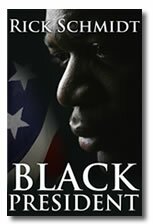
Black President by Rick Schmidt

October 5th, 2008

Black PresidentOn SYNCHRONICITY

In BLACK PRESIDENT there are some surprising simularities between my central character, President-Elect Jackson Little, and that of Democratic Nominee Barack Obama. Here are some synchronistic connections that fell into my story, as I developed it pre-9/11.

1.  Because I grew up in Chicago, Illinois, and felt comfortable with recreating the landscape there, I made my BLACK PRESIDENT character relocate to the South Side with his brother and mother.   And there he became an Alderman and Assemblyman on his way to a Senate seat.  Obama followed the same course, winning those seats and becoming nationally prominent a couple years after I finished the novel’s first draft.

2. I figured that by 2012 only Caroline Kennedy would have the political caché to be a viable Democratic candidate, so I had her running at the top of her party’s ticket.  Some thought this was extremely outlandish, since she had publically dispelled any interest in politics in past newspaper articles and interviews.  But in 2008 Caroline Kennedy Schlossberg jumped into helping Obama as the head of his V.P. search committee!  And Michael Moore thought she should run as his VP, should select HERSELF as Cheney had done when he was the head of Bush’s committee!   Anyway, these are a few of the coincidences that came my way, realities catching up with my fiction!

It always has seemed that synchronicity has been the gift that the universe offers up whenever I’ve launched into a creative project.  When I was beginning the scripting my 4th indie feature, MORGAN’S CAKE (shown at Sundance Film Festival, Berlin Intl., etc.), I knew the movie was about a young man about to turn 18 (I imagined the blowing out of candles on his cake). The lead role was set to be played by my son Morgan, who, in real life, had considered resisting the U.S. draft by not registering on his 18th birthday…So I was creating a movie around his real concerns, as a young person coming of age in 1988.  FYI: Morgan had been named after the Morgan character in the great Karel Reisz comedy ‘MORGAN- A suitable Case For Treatment’ (1966).   In any case, I felt my ‘Morgan’ story was missing some kind of plot point and I wasn’t going to shoot anything until I figured out what it was.  As my creative antenna was scanning the known horizons for answers I spotted a blurb in a local newspaper, which stated, ‘It is illegal to make a pastry in the shape of the White House.’  Suddenly I realized that Morgan could protest the war by baking a cake!   Embracing that concept, I was suddenly gifted with a strong ending, plus an original movie title.  I’m sure my fellow Picnic bloggers have experienced such revelatory synchronistic experiences while doing research on their novels, illustrating books, or creating other kinds of original artworks.

I will be blogging again soon.  Meantime, I handover to Gisela Hoyle and The White Kudu with very best wishes to her and the Picnic community.

Black President by Rick Schmidt

October 1st, 2008

Black PresidentHooray!  It’s pubdate for BLACK PRESIDENT!  Hope I hear from some UK readers soon.

Of course THE UPCOMING US ELECTION is on my (everyone’s!) mind here.  In Black President I have a chapter on how the ‘hanging chad’ punched ballots of 2000 were designed to make it truly impossible to know who you were voting for.  Anyway, I’ve had trouble believing it was just serendipity that messed up the accuracy of that particular ballot.  And now, on to the next round of confusion/deception…

Supporting my concern about the upcoming 2008 Presidential election…just saw a show on TV on a recent local race for city councilman in Florida that had inaccurate counting.  The reporter stated that after the first tally of the local election it seemed the Republican had won by 9 votes.  But then a hand recount revealed that THE DEMOCRAT had actually won…by 130 votes!  And finally, it was discovered that 3500 ballots were missing!!  If we can send a man to the moon (we really did this, right?) then why can’t we get this election thing under control?

For the 2004 election, it was tabulated that 638 people or so voted in a small Ohio community, and yet G. W. Bush received over 4000 votes at that location!  Another fact:  80,000 uncounted votes in Georgia… Here are some of the complaints of Floridians after the 2000 and 2004 elections:

2+ to 15 hour waits (long lines)
Only ONE phone number for precincts (line always busy).
Missing machines.
Poles opening late.
People turned away.
Broken machines w/people turned away.
2 machines for 1300 people,
Faulty vote counting.
Missing ballots.
Inaccurate ‘Felons’ list.
Names removed from lists.
Pre-punched ballots
Cars towed.
And then there’s THE SPIN.  Of recent days, we have the “lipstick on a pig” debacle?  Yes, I know it’s last week’s news, but the point is that the Republican SPIN is up and running at full tilt.  They (Republican spin-masters) take ANY words Obama says, and use the meaning out of context, runing ads on TV that say he called potential Republican VP Sarah Palin a pig…with lipstick on.  McCain used the exact same phrase weeks earlier (’a pig with lipstick on is still a pig’).  Of course millions of impressionable middle-Americans see ads repeated and believe it!  So the damage is done.  And other ads have supposedly made 1/3 of the population believe obama is a Muslim.  And it is infuriating to hear McCain continually say as fact that ‘Obama will raise your taxes.’  How many times does Obama have to re-explain that he’ll lower taxes on 90% and only raise them for people earning over $250,000?   Somewhere in the textbook on ‘winning an election’ it must say that ‘repetition can overcome any fact.’ 

So I’m a little uneasy about what’s coming, and how there will most probably be an entirely new election horror story we can bat around in November!   The latest economic meltdown seems to be gifting Obama with a raised percentage, putting him temporarily ahead in the polls as of late Sept,. but who’s to say it will hold.  I know it’s not healthy to hold one’s breath for a month, but…

Black President by Rick Schmidt

September 29th, 2008

Black PresidentWell, hello again! The countdown to the Oct. 1 publication of Black President is just about here, with only a couple days before it’s out in the world, so please allow me to give Picnic Publishing a huge THANK YOU for believing in my book and getting it to this point!  Wow!   It’s a pleasure and an honor to be back in the blogging-seat, especially now that I’ve read all the other Picnic author’s blogs and realize what lovely company I’m keeping.  So congratulations to all of you for getting your books recognized and heading for print!   Just awaiting the box of my author’s copies to show up so I can gaze upon the final product (I’d better check my mailbox again…)

And now, on to the US meltdowns…
In Black President I’ve tried to connect the dots of how the elite class of big landowners and richest one-percent of America was formed out of the old-boy network, leading right up to, and socially connected with, the US PRESIDENCY.  And suddenly we have these huge ‘corrections’ going on again in the financial markets.  Loans were available to almost anyone who wanted to take on a mortgage a few years ago, and it’s hit the wall with millions of forclosures (question: who makes all the money, whether the market goes up…or down?). Capitalism can’t seem to help breeding this mindset.  At the same time, most of us can’t save enough in this inflationary environment to save or invest in anything! 

Regarding this current meltdowns of US financial markets, the greed-factor seems to be massively at fault.   On this subject, I’d like to run a short piece I wrote as part of my memoir (’Twelve Dead Frogs and Other Stories’) that may be of interest.  In the late 1960’s my life intersected with an old Italian grocer named Joe, who altered my concept of ‘money.’  Please enjoy this short flashback.

*          *          *

JOE’S SANDWICHES
During the summer of 1969, dazed and confused after the breakup of my first marriage, I aimlessly walked the Bay Area streets, hoping to let the poison seep out. Since I didn’t have any destination, no goal of any kind, I was suddenly living in the present more than I ever had before.  When I wandered into any place of business I took my time, looked around at the people and things, even consciously smelled the air instead of just rushing in then out with a purchase, like I do now. 

One day I ducked into a corner grocery on Claremont Boulevard, a block off Telegraph Avenue near 51st Street in Oakland.  As was my new custom, I gazed around me and slowly took it all in.   The small space was poorly lit, the aisles so narrow I almost had to walk sideways.  Wide wooden shelves were stocked with a mix of Italian and American foodstuffs, with dried salamis, cheeses and peppers, brooms and other sundries hanging overhead.  At the end of an aisle there was a free-standing rack of greeting cards from the 1930s, their quaint phrases adding to the ambiance. “Come out of your doghouse and play,”  one said, showing a lovelorn man looking out from the entrance of a doghouse, red hearts floating above his head.  Before the end of that first visit I learned the store was run by an old Italian guy named Joe, who seemed to spend most of his time sitting behind the counter on a short stool.

Over the next few weeks I found myself returning to dawdle awhile, exploring the place like I might a museum.   When I saw a small group of secretaries and businessmen form a line at lunchtime to buy Joe’s homemade sandwiches, I joined in.  His ‘poor boy’ included three kinds of meat, three kinds of cheese on a French roll, and cost only 25-cents.  A quarter!   Even in the late 1960s that had to be considered ridiculously cheap.  An empty French roll cost that much anywhere else.  Didn’t Joe realize a roll with meat and cheese should run at least a dollar?  Was he stupid?  Senile?   What ever he was, I hoped he’d never change.

At some point Joe decided to reduce his quota of sandwich clients to just fifteen, informing me I was still on the list.  He mentioned he’d had the store for twenty-five years.  Pretty long, I thought.  Then he told me his first grocery had been at the insurance storefront right next door, and that he’d been there for thirty-nine years.  Far out!  Joe’s two stores had occupied that same Oakland corner for 64 years, about triple my lifetime at that point.

Joe barely had two words for most of the customers, even for the old Italians who arrived daily to pick up bags of food and sign an old ledger.  No money ever changed hands.  These elderly women (I only saw women) all seemed to wear the same kind of long black coats, and none was ever kept waiting.  He would interrupt his sandwich-making or dealings with customers the second one was spotted at the doorway.  Once, when the ledger was open, I caught a glimpse of what looked like hundreds of tiny scrawled signatures, a sum beside each one.

In late August, when I got hired to set tile on a patio at my College (CCA) I went several weeks without Joe’s lunches.  But one day I got the urge to show off my discovery.   I impulsively invited two student co-workers to join me for ‘the cheapest sandwich in town.’  We drove the quick mile to the grocery, got in line, and I gave Joe our order - three poor boys.  As he went to work cutting rolls, adding meat, cheese, spreading mustard, I began to bask in my upcoming glory.  25-cent sandwiches!  Was I cool, or what? 

After Joe wrapped and bagged the food he suddenly called out in a loud, angry voice, “Rick!  Come over here!”  What was wrong?  I was embarrassed to be so abruptly addressed, could feel a blush rising to my cheeks as the lunchtime crowd and my buddies looked on.  When I reached the counter Joe really let me have it.

“Don’t ever bring anyone in here again!”  he exclaimed, making more eye contact than I was used to.  Before I could think straight, recover from my humiliation, the agitated old man lowered the boom.  “Don’t you know it costs me more than twenty-five cents to make these sandwiches?!” 

Oh my God!  He’d known all along!  No one had ever gotten away with anything!  I started to say something, but nothing came out.  Finally the word ‘Why?’ escaped my lips.   Joe’s expression suddenly changed from anger to a mix of something between pity and disgust.  Still speaking gruffly, but with a kind of resigned energy, the old Italian declared, “Somebody’s gotta do something for this country.”

*         *          *

So here was an old Italian immigrant thinking he could help America by selling his hand-made sandwiches at a loss while giving free bags of food away to the local community!  Not quite the typical capitalistic modes operandi!  I’d like to think that Joe’s shockwave had something to do with the creation of my how-to book, FEATURE FILMMAKING AT USED-CAR PRICES, written 17 years after the 25-cent sandwiches.   Since people regard the cost of a feature film to be millions of dollars, not thousands from the sale of a used-car, my book helped some artists rethink the possibilities.  So maybe I unconsiously carried Joe’s example forward.

What still captures my imagination is wondering how Joe decided on that course of action.  What experiences did he have growing up that drove him to do it? (I’m currently doing some research in the Italian community, to see if anyone remembers him and can supply some facts about his life)  At any rate, he is a hero of mine and I feel  responsibility for helping his story live on (thanks blog!).

The Dinosaur & Dragon Juice Café by James Anthony Crabb

September 26th, 2008

Illustrating: Evolution, Research & Mistakes along the way

Creating my first book “The Dinosaur And Dragon Juice Café” I ran into many challenges.
Firstly designing of the characters, their sizes, shapes, colours, expressions, etc.
I sent my first drawings off for the authors blessing, these were promptly turned down for being too Disney like (big feet, gloved hands) and lacked colour.

My second attempt was better, colours ok, but too old fashioned.
I was asked to modernise everything, for example by adding a modern car for Grandad, who should look younger, trendier clothes for the special children, trainers for the main characters, fiercer looking dinosaur and dragon, not too much trouble!


The story having been aimed at 6 to 7year olds had to include special children of similar age, this meant (with the help of my wife) hiking round stores and supermarkets, looking at children’s clothes and shoes, researching catalogues for the mentioned trendier look, studying little faces, and looking at mango’s, their shapes and colours.

I tried many types of media for the drawings, ink pens, acrylics, watercolours and fluorescents, I finally settled for watercolour pencils, a good choice I think. I found these were perfect for shading, blending, very clean to work with, and brushing in afterwards with water, I could achieve excellent results very quickly.

Unfortunately mistakes were made along the way proving to be a costly venture, sometimes a nightmare, mainly because they seem to appear at the end of a drawing, often resulting in redrawing (with the help of a light box), and patching which then has to be blended on the computer.
I hit on the idea of using Tippex, easy to cover! Great, but to my sheer horror showed up glowing white in the final scanning.
This led to last minute panic of retouching using Photoshop on the computer, obviously not having enough time to redraw.

Conclusion, I must be more careful in preparation and correctly confident before finishing off.
I have learnt many lessons in putting the illustrations together for this book, firstly use of a computer (for scanning, printing and text), research has been time consuming, use of the internet would have been a great asset, so hopefully I will be connected soon.

I really should mention the excellent advice and help I have received from my good friend Caroline Bailey (illustrator of the Sleepy Ladybird) who has spent many hours vetting and correcting my work, I am very grateful, without her I would not have succeeded in this task.

Next on the Picnic Blog is a change of scene with Rick Schmidt author of Black President - Stay Tuned!

Thank you,

James A. Crabb

The Dinosaur & Dragon Juice Café by James Anthony Crabb

September 25th, 2008

ILLUSTRATING A BOOK, EASY?

Before doing children’s books illustrations, I never realised the complexity of illustrating a book.

Apart from drawing, reading text over and over again, matching drawings to text, being sure, because changing text or drawings can lead to ongoing problems later on throughout the book, researching, using models etc, stabilising characters features, working with colours and making many notes for future reference, is there no end ?

Planning most importantly, putting together a mock up book, scanning, copying, doing test prints and final printing, and hopefully lead on production.
Was it worth it? YES.

My first book is in the process of printing and will soon be on sale which is a very exciting feeling.
I would like to say a big thank you to Picnic Publishing for giving me the opportunity to become an illustrator.

Thank you, (this is not a goodbye though as I will be publishing my last and best blogpost tomorrow!)

James A. Crabb