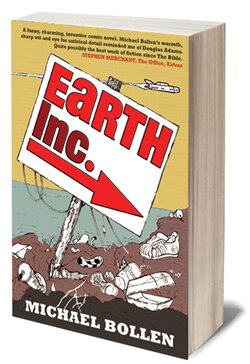
by Michael Bollen
ISBN: 978 0556105 3 0
356pp paperback
£9.99
"A funny, charming, inventive comic novel. Michael Bollen’s warmth, sharp wit and eye for satirical detail reminded me of Douglas Adams. Quite possibly the best work of fiction since The Bible."
Stephen Merchant, The Office, Extras
|
Extract 1: The Beginning
The public conveyer belt snaked its way through London, rattling and occasionally killing people. Encased in a plastic tube, the travelator undulated over obstacles and through buildings, swallowing and regurgitating its prey at regular intervals. One such victim was Jorj Parka, who had hopped into the belly of the beast at London Bridge station, and who now hoped to survive as far as Vauxhall.
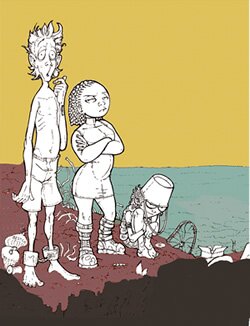
Jorj took little care with his appearance. His hair stuck up at odd, unfashionable angles and his shirt was half tucked. His shoes were so out of fashion they were on their way to being retro and his trousers were creased in all the wrong places. Only Jorj’s teeth were well maintained. As a pessimist, Jorj responded better to threats than to promises. The fear of toothache made him floss three times a day, but the hope of some female attention could not persuade him to brush his hair. At seventeen years of age Jorj had youth on his side, but the rest of the universe was against him. His tall, skinny frame tottered along on beanpole legs, his ungainly motions resembling the work of a sloppy puppeteer. Jorj staggered down the moving walkway, scowling, tutting and knocking into people with the vicious disregard for strangers that is symptomatic of large city life. He was running, late.
Jorj ascended a particularly steep section of the belt, and was afforded a tremendous view of the ceiling. Rows of screens covered the interior, like flickering technicolour scales. On the right-hand side of the tube, where people stood rather than walked, the images progressed from screen to screen in synch with the belt. The seamless flow of commercials enclosed the commuters with images of freedom: cloudless skies, car-less roads and empty beaches. Each vision of paradise was tagged with a logo, perfection being branded as surely as the mind of the viewer. Trademarks were burnt indelibly on the brain like badges of ownership.
On the other side of the tube the ads were shorter, brasher and brighter, targeting people on the move. ‘Sport = OK Cola’ flashed one above Jorj’s head. ‘Happy Happy Happy Happy O’Connels Burgers Happy Happy’ beamed another. ‘Wipe that smile on your face with Hygex Toilet Tissue’ insisted a third. Speakers in the tunnel muttered slogans, reinforcing the connections. Jorj’s conscious mind paid them no attention as he hurried along, cursing and pushing as he went.
He checked his lifePod every few steps, hoping for time to slow down. As well as the time, the screen embedded in his wrist displayed various other pieces of information. The temperature scrolled from left to right, followed by Jorj’s name, which would have been spelt “George” had his birth not been registered by text message. He flashed his lifePod ostentatiously at his fellow travellers. They ignored him, being either too wrapped up in their own misery or not geeky enough to recognise the gadget’s special specifications. Jorj dropped his arm bitterly. It had only been plumbed into his vein a few weeks ago, and he was still absurdly proud of it.
An unseasonably cold wind whipped down the tube, and the overhead screens showed nothing but snow. Jorj was approaching one of the many breaches in the tunnel, the movement of the crowd ahead betraying its location. The commuters in front of him squeezed onto the left-hand side of the belt, and a glimpse of grey daylight was visible on the right. Jorj had no time for such niceties of personal safety. He jogged ahead, pushed past yet another fleshy obstacle and teetered momentarily on the brink.
The belt was crawling west along the southern bank of the Thames, several hundred metres up in the air, and London lay spread out below. As always it was a hopeless tangle of young and old, ugly and beautiful, celestial and corporate. St Paul’s Cathedral was just visible behind its newer, shinier companions, poking desperately through the crowd like the shortest child in a school photograph. To the left were the Houses of Parliament, mostly hidden behind the protective steel wall that enclosed Whitehall. The usual queue of traffic stretched across Westminster Bridge, waiting impatiently to be checked into the terror-free haven behind the screen. Big Ben loomed above the barrier, its reconstructed Mickey Mouse faces a reminder of the bomb attack that had necessitated the wall in the first place. In the Commons below, an emergency session was taking place. Large oil reserves had been found in Namibia, and the MPs were trying to decide on a pretext for invasion. The Prime Minister claimed that the President of Namibia had made a rude remark about his knees, but the leader of the Opposition felt a stronger reason was needed. She favoured creating a climate of fear with rumours of dinosaur resurgence. The debate continued.
Jorj had no time for politics. He wondered, as he did several times a week, whether the hole in the tube had been caused by a terrorist attack or the more deadly combination of cost cutting and British workmanship. He was thankful that his journey didn’t take him over the Thames far below. Most weeks someone would fall from the dilapidated transport system and into the swollen river, which today had a sickly pinkish tinge. A gust of wind slapped his face with drizzle, and Jorj hurried onwards. He considered throwing an obstructing commuter out of the hole, but for some reason standing on the left still wasn’t a capital offence. Jorj contented himself with knocking against the blockage rather more rudely than necessary.
Jorj arrived at work just in time. He ran his lifePod past the scanner, the door opened and he stepped through as the clock on the wall changed to 9.30am.
Thank God, he thought. He had been late twice already this week and could ill-afford another trip to see the boss. Even in an office packed with slackers and ne’er-do-anythings, he was sometimes known as The Late Jorj Parka.
Most people were allowed to work from home. Video conferencing, the net and terrorism had all contributed to the trend, one that Jorj and his colleagues had been unable to follow. Jorj had been employed for three months now, having run out of education vouchers just after his seventeenth birthday. He had been a home worker initially, but had taken a few too many vid calls whilst obviously lying in bed. All his calls were monitored, and his occasional shouts of ‘Take that you goblin scum!’ had baffled customers and convinced his bosses that Jorj was playing games on company time. Within a month he had been sent to the office, to join the others who couldn’t be trusted to work unsupervised. Jorj’s parents had been pleased with this demotion; it got him out of the family home for nine hours a day, and they nursed a secret hope that the experience may finally give him a sense of purpose. This had proved to be the case; after two months of commuting, Jorj was determined to find a job he could perform from his bed, if not actually in his sleep.
As Jorj walked through the office’s small lobby area, a robot receptionist turned its head to follow his movements. The machine was humanoid in shape, with a grating voice and a painted on smile, not so different from the flesh and blood version it had replaced some years earlier. Within a fraction of a second it had cross-referenced the information its cameras were “seeing” with its collection of staff members’ photos. ‘Good morning Jorj,’ it said.
‘Good morning Alex,’ said Jorj.
‘Or should I say “Good afternoon”?’ continued the machine.
‘You’ve still got the sarcasm virus then?’ Jorj asked.
‘No, I’ve been repaired,’ sneered the robot.
‘You want to watch it,’ said Jorj as he walked past the reception desk. ‘With an attitude like that, you could end up with my job.’
If it wasn’t for pro-human employment legislation, the machine could have filled Jorj’s position with ease, a depressing thought that he tried to evade as he entered the call centre.
It was a vast room, dotted with output pods (or “workstations” as they used to be known). The large gaps between each pod were supposed to prevent illicit contact between neighbours. At the far end of the room was a raised platform upon which a supervisor paced, glaring down at his charges. As Jorj crept towards his pod, two of his colleagues were being reprimanded. ‘Jesica, Rach-L. If it’s that funny, perhaps you’d like to share it with the rest of the office?’ the supervisor boomed.
Jorj scurried towards his workstation (or “desk” as it had been known in simpler times). He dropped heavily into his chair, narrowly avoiding a paper aeroplane thrown by one of his co-workers. Reluctantly, he clamped tiny speakers to his ears, which beeped as soon as he activated his computer.
‘Good morning valued customer, welcome to We Care,’ Jorj sang as he stuck a microphone on his throat. ‘How may I enhance our relationship and improve your life?’ he continued cheerily.
I wish I was dead, he thought.
The tortoise of time was crawling its way towards Jorj’s midmorning break when his screen suddenly turned blue. ‘Although your conversation is enriching and enlightening, I need to put you on hold for one moment,’ said Jorj to the caller in his ear, before realising that they had been disconnected. Jorj pressed a button on his lifePod to open direct communications with his computer, and asked it what was going on.
‘I do not understand,’ said the computer, its calm female voice emanating from Jorj’s headphones.
Jorj shifted nervously in his chair. Nothing like this had ever happened before. ‘Computer, open the Help File.’
‘File missing.’
Jorj had never heard that message either. ‘Open backup Help File,’ he ordered.
‘File missing.’
‘Display available files.’
‘No files available.’
Jorj was an only child raised by video games. He was good with machines, much better than he was with people. He understood how technology worked and he wasn’t afraid of it. Yet for the first time in his life Jorj was experiencing Big Red Button Syndrome. This was the fear of accidentally pressing the wrong key and wiping a computer’s memory, unleashing a virus or, in extreme cases, blowing up the world. The rational part of Jorj’s brain knew that no sane designer would create such a button, but it was still a few moments before he plucked up the courage to report the problem. ‘Open an email to tech support,’ he said.
‘An unknown error has occurred.’
‘What the hell kind of use is that?’ Jorj snapped. ‘How can it be unknown if you’re telling me about it?’ The computer’s reply made Jorj really panic.
‘Panic,’ said the computer. The word ‘Panic’ also flashed on the screen. A few seconds later it changed. ‘Now run and tell your boss.’
Jorj stood up and edged away, unable to tear his eyes from the screen. Maybe the big red button is under my desk, wailed the irrational part of his brain. Maybe I knocked it with my knee. Eventually he turned and rushed towards the supervisor’s platform as fast as he could. This wasn’t very fast, as everyone in the room was trying to do the same thing.
Half the world was trying to do the same thing.
More about Earth Inc.
|
|